


Description
Mother Plant Description
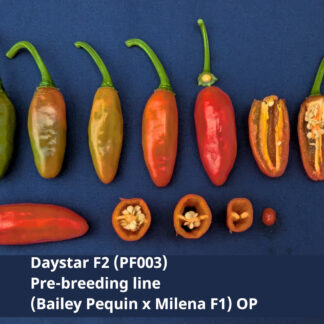
The F1 plants are upright and moderately branching/spreading, with sturdy stems and a well-balanced, uniform canopy. Pequin contributes toughness, stress tolerance, volatile aromatics, and other wild-type traits, while Milena F1 contributes disease resistance, uniformity, strong vigor, and improved horticultural structure. Foliage is medium green with consistent internode spacing.
Fruit Description
F1 fruits are conical to slightly elongated annuum pods with moderate wall thickness and a thick exocarp. They soften at ripening and readily detach from the pedicel (functionally dehiscent). Fruits carry strong pequin-derived volatiles with high pungency. Color transitions from a clearer bright green to rich red at maturity. Flavor shows intense pequin volatiles over a sweeter annuum background. Heat is moderate–high with broad segregation expected in the F2.
Culinary & Processing Goals
This cross aims to merge wild pequin aromatic depth with Milena F1’s larger fruit size, thicker flesh, enhanced sweetness, and improved storage/processing performance. Goals include a superior blend of high-density volatiles, flavor complexity, and texture suitable for fresh use, fermentations, and sauces. Milena contributes modern sweet-pepper fleshiness and uniformity; pequin contributes ancient volatile chemistry and richer ripened mouthfeel.
Breeding Notes
Expect wide segregation and strong contrasts between pequin and domestic alleles.
FRUIT TRAITS
- Larger fruit size with blocky, conical, or stable appealing shapes; consider both fruit mass and total yield.
- Soft, easily detaching fruit common in segregants; search for firmer phenotypes representing ripening or abscission-zone variants.
- Thickened flesh and improved juiciness for better processing.
- Retention of pequin aroma and volatile complexity.
- Heat from mild to very hot — select for no-heat pequin-like flavor or your preferred pungency level.
PLANT TRAITS
- Stress tolerance, especially drought and heat resilience.
- Improved branching structure with a low internode count before flowering, providing compact, efficient architecture.
- Extended production window with early fruit set, late-season continuation, and better flowering during cool nights.
License
Released under the OPB MTA.
Reviews
There are no reviews yet.